tickets:
regular: 14,- €uro
students, disabled persons: 7,- €uro
doors: 7.30 pm CEST
concert starts:
approx. 8.00 pm CEST
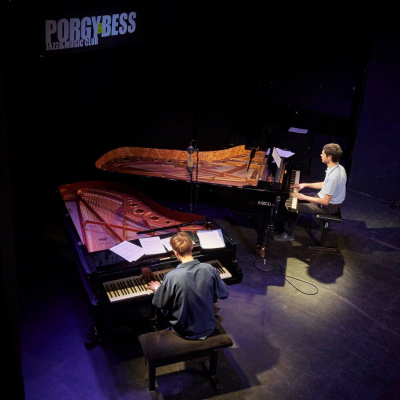
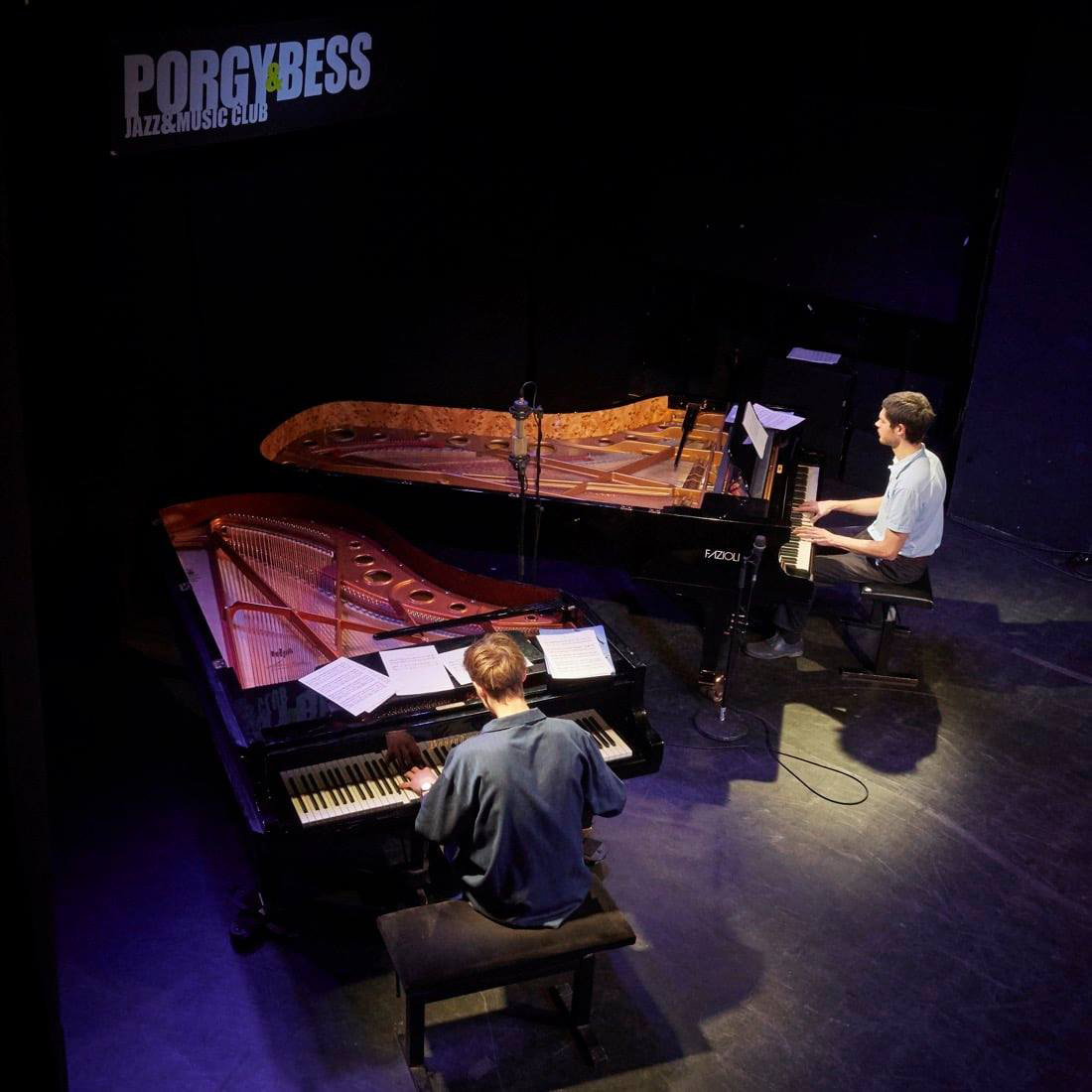
This evening will feature a new program for two grand pianos, compiled from various compositional cycles by the two pianists—expanding on the repertoire of their debut recording DDIOFEO (Schattellit, 2022).
The approach to different textures and intensities in harmony through an overarching tonal group concept forms the basis for dividing variable definitions of consonance and dissonance into temporary levels and allowing them to communicate with each other through a sensitized understanding of twelve-tone music. This awareness of variable bracketing brings together different focal points in this duo repertoire: above all, it is brought to audible light in an improvisational manner. Based on a broad compositional concept, this results in a combinatorially numerous temporary division of roles in the four-handed ensemble. Clearly or fluidly intertwined, twenty fingers create a plastic sound body that is both conceptually and spontaneously intuitive, alternately contracting and expanding....
read more
tickets:
regular: 14,- €uro
students, disabled persons: 7,- €uro
doors: 7.30 pm CEST
concert starts:
approx. 8.00 pm CEST
This evening will feature a new program for two grand pianos, compiled from various compositional cycles by the two pianists—expanding on the repertoire of their debut recording DDIOFEO (Schattellit, 2022).
The approach to different textures and intensities in harmony through an overarching tonal group concept forms the basis for dividing variable definitions of consonance and dissonance into temporary levels and allowing them to communicate with each other through a sensitized understanding of twelve-tone music. This awareness of variable bracketing brings together different focal points in this duo repertoire: above all, it is brought to audible light in an improvisational manner. Based on a broad compositional concept, this results in a combinatorially numerous temporary division of roles in the four-handed ensemble. Clearly or fluidly intertwined, twenty fingers create a plastic sound body that is both conceptually and spontaneously intuitive, alternately contracting and expanding.
The dynamics of the tonal movement develop throughout the evening program via compositionally vague yet highly precise fields predetermined by the pianists. The encounter between the internalized improvisational expressive possibilities, which are openly oriented in all directions, gives rise to a constantly reexamined urgency to continue the chain of associations born in the moment; in the field of strongly polyrhythmic structures, in measured, slowly carried songfulness, in impulsive chordal vehemence, in hide-and-seek with motivic clarity, in the examination of affinities, in formal masquerading, in intervallic pole vaulting, as well as in the spreading of gently ascending and descending sound slopes.
https://www.georgvogel.net/
https://elias-stemeseder.com/
At the intersection of jazz, improvisation, and electronic music, Elias Stemeseder (born in Salzburg in 1990) is one of the most distinctive pianists and sound explorers of his generation. Trained in classical music from an early age, he turned his attention to jazz as a teenager and studied at the Jazz Institute Berlin, among other places, where he decisively shaped his artistic signature.
Stemeseder gained international recognition through his long-standing collaboration with US drummer Jim Black. In the Jim Black Trio and other projects, he developed a unique sound language that combines rhythmic complexity, harmonic openness, and a joy of sonic experimentation. In addition to the acoustic piano, he works intensively with synthesizers, samplers, and electronic setups—always with the aim of taking improvised music into new sonic spaces.
Stemeseder is in demand both as a sideman and as a bandleader, moving confidently between the European and New York scenes. He has worked with avant-garde composer John Zorn and numerous influential voices in contemporary improvisational music. His projects, such as the Stemeseder-Lillinger duo, exemplify an uncompromising, energetic aesthetic that blends jazz, new music, and electroacoustic research.
His solo album Piano Solo (2022), released on the Swiss label Intakt Records, is an artistic milestone. It showcases his entire range: from fragile, introspective sound poetry to structurally dense, rhythmically complex improvisations. The album underscores his reputation as a pianist with exceptional formal clarity and tonal vision.
In 2023, Stemeseder was awarded the German Jazz Prize as Pianist/Keyboardist of the Year. He was also Artist in Residence at the legendary New York venue The Stone, a central location for avant-garde music.
Today, Elias Stemeseder commutes between Europe and the US and is considered the defining voice of a generation that understands jazz not as a style but as an open field of artistic exploration. His music stands for radical curiosity, technical precision, and the consistent expansion of pianistic expression into acoustic and electronic dimensions.
Georg Vogel (born in Salzburg in 1988) is an Austrian pianist, composer, improvisational musician, instrument maker, and a central figure in the contemporary jazz and improvised music scene. He grew up in Salzburg and began taking classical piano lessons in 1995; he later studied jazz piano and composition at the Music and Arts University of the City of Vienna, where he graduated with honors in 2011. He also attended workshops with renowned musicians such as Jim Black, George Garzone, Ralph Alessi, and Drew Gress.
Vogel is particularly well known for his experimental exploration of microtonal tuning systems, especially 31-tone systems that go far beyond the conventional 12-tone octave. To this end, he has developed and built several instruments of his own, including various versions of the 31-tone Claviton keyboard, which enable him to realize novel soundscapes and expanded tonal spaces.
As a musician, he is active in numerous formations and ensembles of his own. He leads the ensemble Dsilton (with David Dornig and Valentin Duit) and is a founding member of groups such as Flower (with Raphael Preuschl and Michael Prowaznik) and Tree (with Andreas Waelti and Prowaznik). He also plays in the trio GeoGeMa (with Gerald Preinfalk and Matheus Jardim) and performs regularly as a soloist or in duos, including with pianist Elias Stemeseder.
Vogel’s musical approach is characterized by a deep curiosity about rhythmic and harmonic innovation, improvisation, and the interplay of compositionally structured elements with free sonic explorations. His works move at the intersection of jazz, new music, and experimental sound research and are considered inspiring for the contemporary improvisation scene.
His awards include several prizes from his early years, including the Fidelio Competition of the MUK in Vienna (2009 and 2010), the Annual Scholarship for Music of the Province of Salzburg (2019), and the Promotion Prize for Music of the City of Vienna (2024).
show less